
Real-time intelligence for contested news.
When a story is breaking and the facts are still forming, Contxt aggregates the full picture across global sources and structures it into what is confirmed, what is claimed, what is disputed, and what remains unknown. Contxt doesn’t offer a verdict of its own, and every source is named and linked to the original.
The problem
When news breaks, finding out what is actually true means hours of searching through partisan, US-centric, secondhand coverage.
90% of Americans encounter news they believe is inaccurate, and 51% say it is hard to tell what is true. (Pew, 2025)
The tools people reach for were built for other jobs. A search engine returns a ranked list of links, and the AI summaries people increasingly turn to misrepresent the news 45% of the time (EBU/BBC, 2025). Community Notes waits for a crowd to agree, and a fact-check arrives days later with a verdict. Each was built for a story that has already settled, rather than one still unfolding.
The product
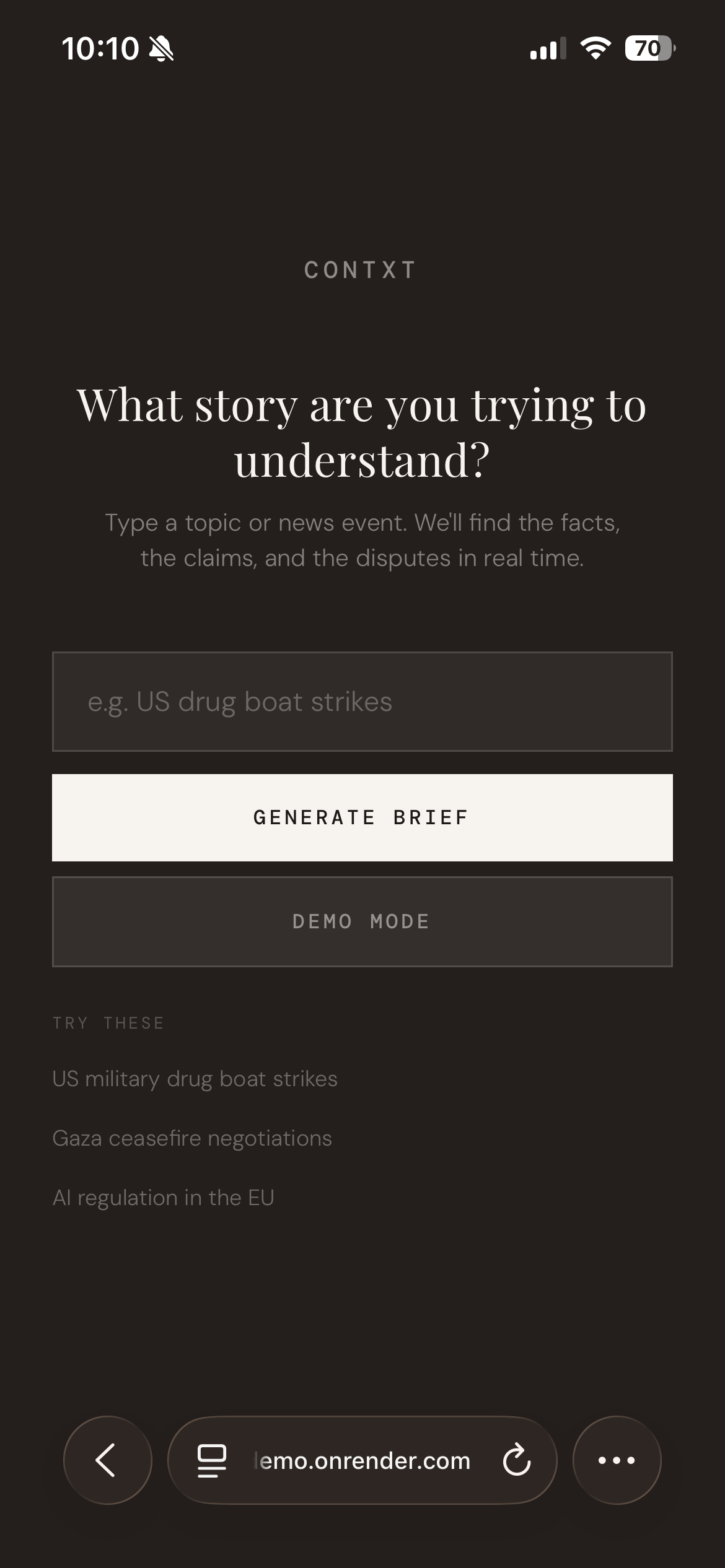
A Contxt brief generates on demand and takes about thirty seconds to read, enough to form a view and move on.
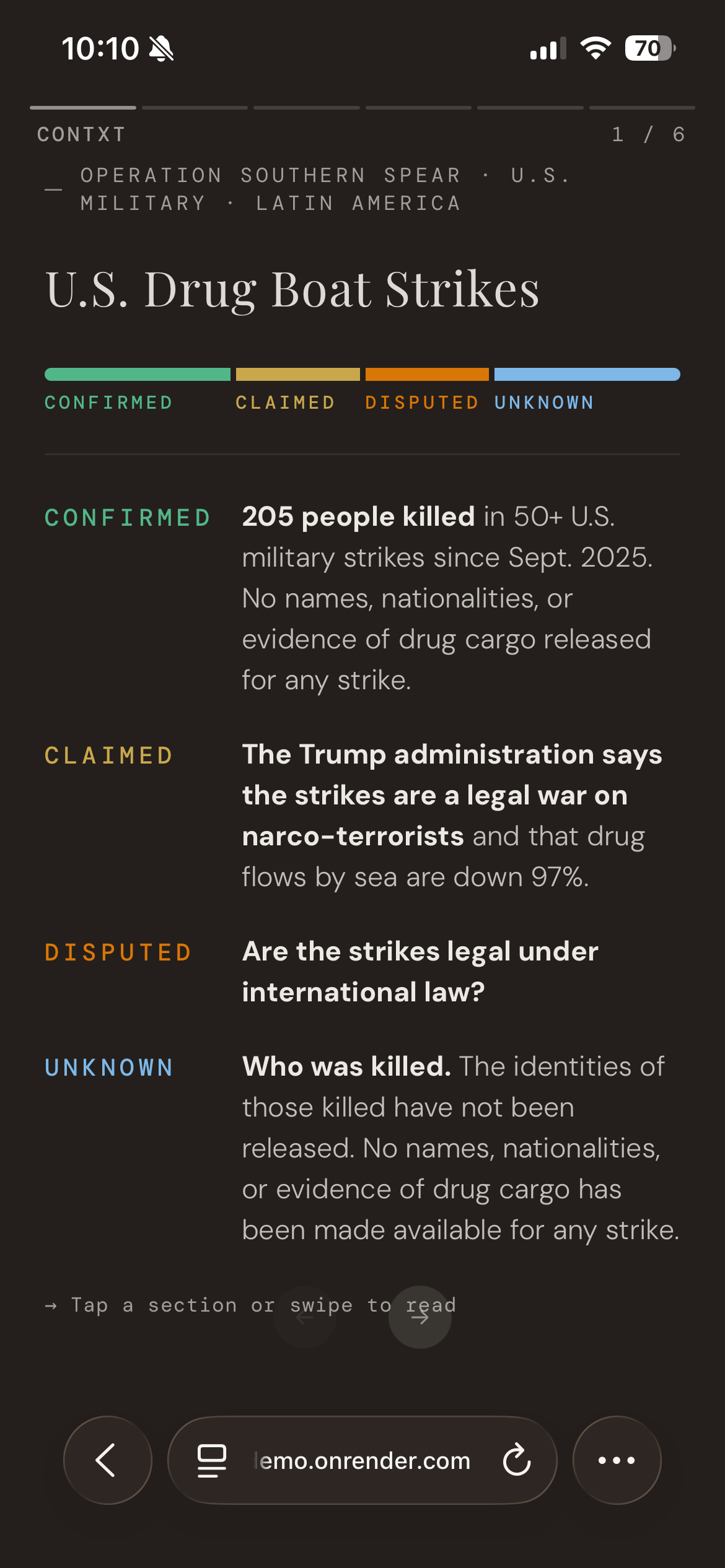
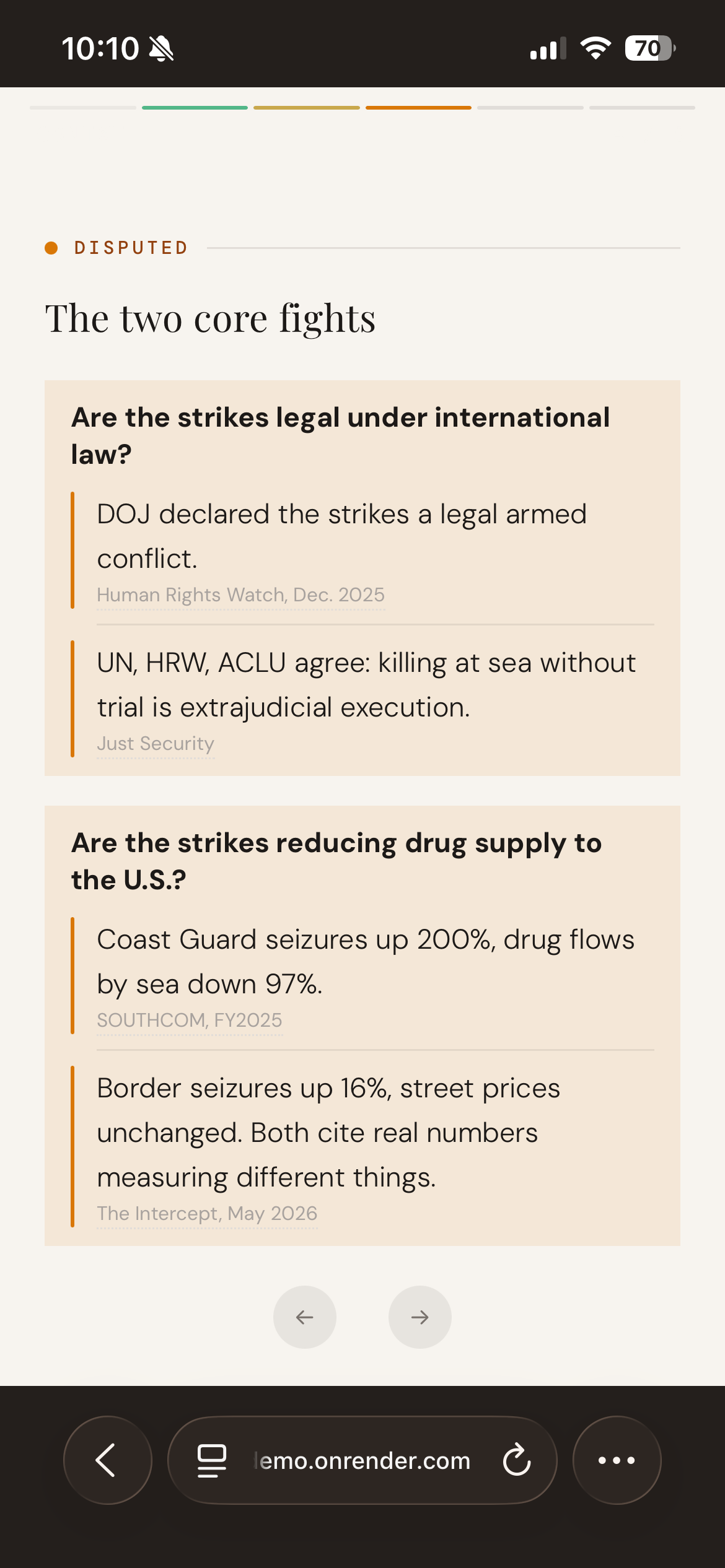
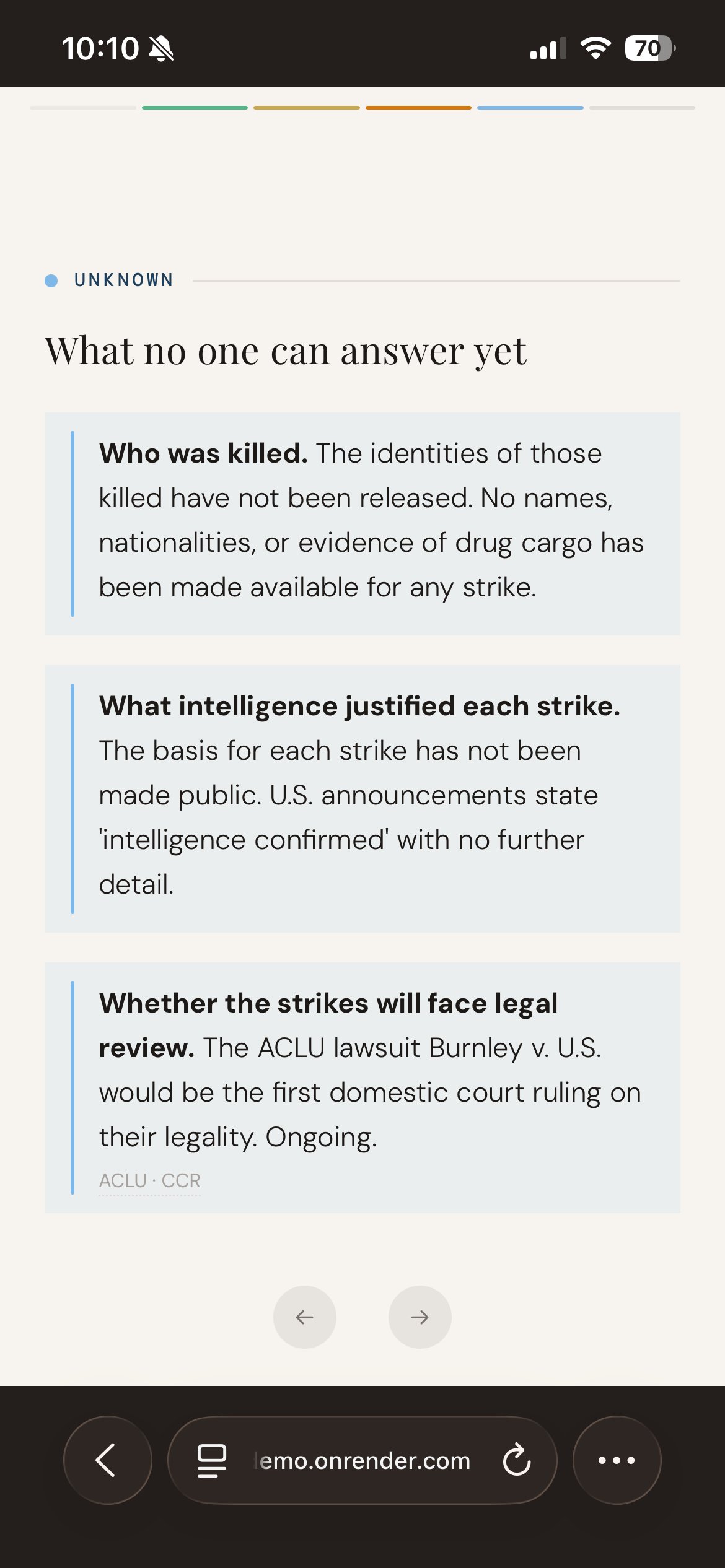
Contxt brief summary: U.S. drug boat strikes, with confirmed, claimed, disputed, and unknown at a glance.Contxt brief disputed slide: the two core fights, with sources on each side.
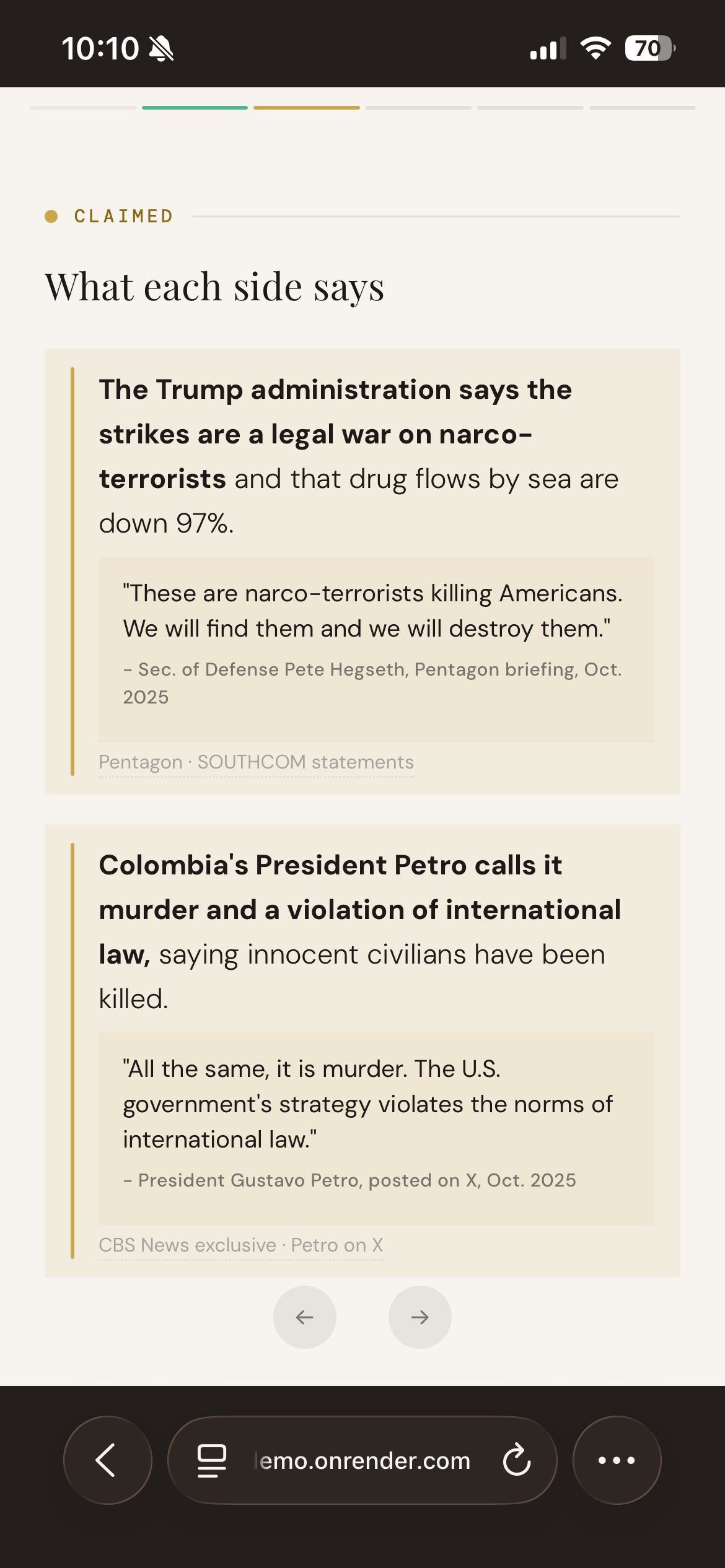
A brief opens with the summary above. Each section expands: shown here is what is disputed. The full brief also details what is confirmed, claimed, and unknown, plus a complete source list.
Built for accuracy
Accuracy is the core of the product. The framework names what is disputed or still unknown instead of forcing a false resolution, and a fact reaches the confirmed tier only with two or more reputable sources behind it. The methodology is built to be audited and refined by independent fact-checking organizations, which gives the output a legitimacy a platform cannot grant itself.
Why now
The information environment is getting worse, fast. Volume keeps climbing, a growing share of content is machine-generated, and there is less basis for trusting any single source.
50% of articles published on the web are now AI-generated. (Graphite, 2026)
12% of people are comfortable reading AI-written news. (Reuters Institute, 2025)
As machine-generated content floods the web, a source you can trace and verify is what stands out.
B2B infrastructure
Contxt is live today as a consumer web product. Next, we’ll surface briefs inside social comment threads, and build an app that creates a brief for any social post. The larger model is B2B2C: platforms integrate via API and serve briefs in whatever format fits their users.
Platforms need it for two reasons. Demand is growing, with EU Digital Services Act enforcement escalating through 2026. And the alternatives don’t work. Community Notes is becoming even less effective as AI accounts take over note creation (Indicator, 2026).
They don’t want to build it themselves, because maintaining a global, multi-language source catalogue is constant work outside their core business, and because reporting on contested news themselves invites accusations of editorial bias.
Integration lets platforms offer trustworthy context on breaking news without becoming the arbiter of it.